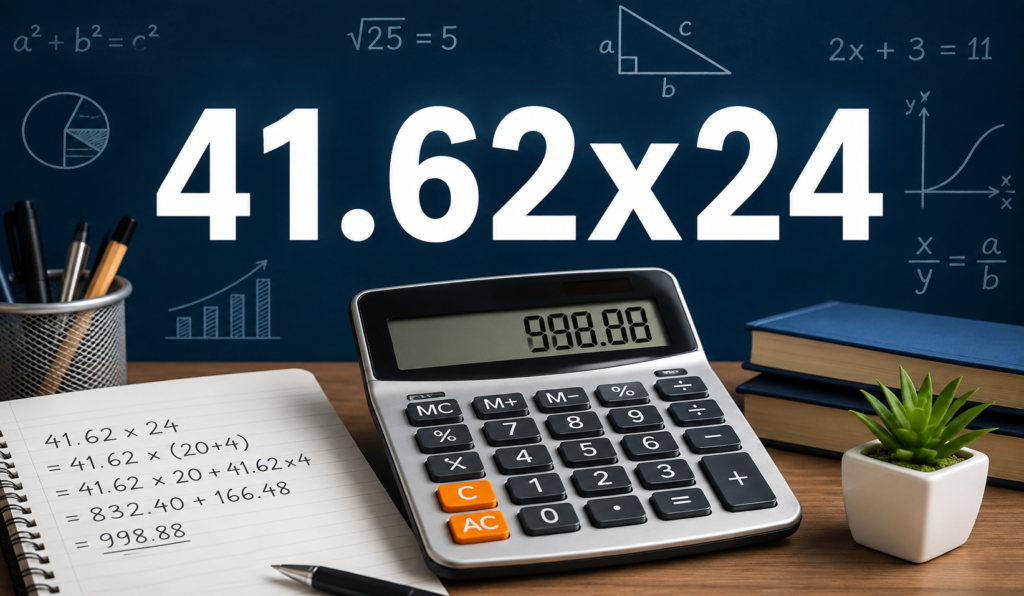

The exact answer to 41.62×24 is 998.88. The calculation can be written as 41.62 × 24 = 998.88. This means that twenty-four units of 41.62 have a combined value of 998.88. Because 41.62 contains two digits after the decimal point, it is important to preserve the decimal correctly during the calculation. A misplaced decimal can turn a correct multiplication into a completely different number. The easiest way to verify the answer is to break 24 into 20 and 4, calculate each part separately, and then add the two results together. This produces 832.40 plus 166.48, which equals 998.88. That quick check confirms the result without relying on a calculator alone.
What Does 41.62×24 Mean?
The expression 41.62×24 contains two numbers: 41.62 and 24. The letter-like symbol “x” represents multiplication, so the expression asks you to multiply 41.62 by 24. Unlike addition, where numbers are simply combined, multiplication represents repeated groups. In this case, you can think of it as twenty-four groups of 41.62. That interpretation is particularly useful when the numbers represent something practical. For example, if one item costs 41.62 and you need 24 of them, multiplying the unit price by the quantity gives the total before any additional taxes, discounts, or fees. The same idea works for measurements, production quantities, area calculations, time-related figures, and many other everyday situations.
How to Calculate 41.62×24 Step by Step
One of the clearest ways to calculate 41.62 × 24 is to split 24 into two smaller numbers: 20 and 4. First, multiply 41.62 by 20, which gives 832.40. Next, multiply 41.62 by 4, which gives 166.48. Finally, add those two results together: 832.40 + 166.48 = 998.88. Therefore, 41.62 × 24 = 998.88. This method is useful because it turns one multiplication problem into two simpler calculations. It also makes the answer easier to verify mentally. If you are checking a calculation without a calculator, breaking the second number into convenient parts is often faster and less confusing than attempting the entire multiplication in one step.
The Decimal Method Behind 41.62×24
There is another useful way to understand the calculation. You can temporarily remove the decimal point from 41.62 and treat the number as 4,162. Because 41.62 has two digits after the decimal point, you later move the decimal point two places back in the final result. Multiplying 4,162 by 24 gives 99,888. Moving the decimal point two places to the left produces 998.88. This approach is commonly taught when learning decimal multiplication because it allows you to work with whole numbers first. The important part is remembering how many decimal places the original number contains. Since 41.62 has two decimal places, the final answer must account for those two places. This provides another independent way to confirm that 998.88 is the correct result.
Why the Answer Is 998.88
At first glance, 41.62 multiplied by 24 might seem close to 1,000, and that provides a useful mental check. If you round 41.62 to approximately 42, then 42 × 24 equals 1,008. Since 41.62 is slightly smaller than 42, its actual product should also be slightly below 1,008. The exact result, 998.88, fits that expectation. Mental estimation like this is a surprisingly useful habit because it can immediately expose major calculation mistakes. If someone entered the expression incorrectly and received 9,988.80 or 99.888, a quick estimate would show that something had gone wrong. Good calculation is not only about getting a number; it is also about knowing whether that number makes sense.
41.62×24 in Everyday Calculations
A multiplication expression such as 41.62 × 24 can appear in many ordinary situations. Imagine a service that costs 41.62 per day and is used for 24 days. The basic cost would be 998.88. Similarly, if a business sells 24 units at a price of 41.62 each, the total sales value before other adjustments would be 998.88. A measurement-based example works too. If a repeated section has a length of 41.62 units and there are 24 identical sections, multiplying the two values gives a combined length of 998.88 units. These examples show why decimal multiplication matters outside school mathematics. Prices, dimensions, quantities, rates, and measurements frequently contain decimal values, so being comfortable with expressions such as 41.62×24 can make everyday calculations much easier.
Using 41.62×24 for Price Calculations
When 41.62 represents a price, multiplying it by 24 gives a straightforward subtotal of 998.88. However, it is worth remembering that a real purchase may involve additional factors. Taxes, delivery fees, discounts, service charges, or other adjustments could change the final amount. For example, if a product costs 41.62 and someone buys 24 units, 998.88 represents the price before those additional adjustments. If there is a discount, the discount should generally be calculated according to the applicable terms before arriving at the final payable amount. This distinction is important because a multiplication result is not always the same thing as a final invoice total. The expression gives you the mathematical product, while the real-world context determines what happens afterward.
Using 41.62×24 for Measurements
Decimal multiplication is also common when dealing with physical measurements. Suppose a measurement of 41.62 inches, centimeters, meters, or another unit needs to be repeated 24 times. The multiplication gives a total of 998.88 of the same measurement unit. The numerical answer itself does not determine the unit; the context does. If the original value is 41.62 meters, the result is 998.88 meters. If the original value is 41.62 centimeters, the result is 998.88 centimeters. This is an important mathematical habit: always carry the correct unit alongside a measurement. A number without its unit can be incomplete, especially when the calculation is being used for construction, manufacturing, design, engineering, or another practical purpose.
How to Check 41.62×24 Without a Calculator
You do not always need a calculator to verify 41.62 × 24. A simple mental check starts by recognizing that 24 is close to 25. Multiplying 41.62 by 25 is equivalent to multiplying it by 100 and dividing by 4, which gives 1,040.50. Because 24 is one less than 25, subtracting one 41.62 from 1,040.50 gives 998.88. This is an especially neat verification because it reaches the exact answer using a convenient number. The calculation can therefore be viewed as 41.62 × 25 − 41.62, resulting in 998.88. Learning these small shortcuts can make decimal arithmetic feel much less intimidating and can be helpful when you are away from a calculator.
A Quick Comparison With Nearby Values
Looking at nearby values can also help explain why the answer makes sense. Multiplying 41 by 24 gives 984, while multiplying 42 by 24 gives 1,008. Since 41.62 falls between 41 and 42, its product with 24 should fall between 984 and 1,008. The answer 998.88 does exactly that. This type of range check is a basic but powerful mathematical technique. It does not replace an exact calculation, but it gives you confidence that the final number is reasonable. When working with financial figures, measurements, or large sets of data, these quick checks can catch typing mistakes before they become larger problems.
41.62×24 and Spreadsheet Calculations
If you are using a spreadsheet, the same multiplication can be entered as a simple formula. In most spreadsheet programs, typing =41.62*24 into a cell will return 998.88. The multiplication symbol in spreadsheet formulas is usually an asterisk rather than the letter x. This distinction matters because spreadsheets use specific mathematical operators to interpret formulas. If 41.62 and 24 are stored in separate cells, the formula can instead reference those cells, making the calculation reusable when the numbers change. This becomes particularly useful for budgets, inventory records, sales calculations, invoices, and other documents where the same mathematical relationship needs to be applied repeatedly.
Common Mistakes When Calculating Decimal Multiplication
One of the most common mistakes with an expression like 41.62 × 24 is placing the decimal point incorrectly. Another mistake is multiplying only the whole-number portion and forgetting the decimal portion entirely. Some people also enter 41.26 instead of 41.62 when typing quickly, which produces a different answer even though the expression looks similar. A good habit is to read the numbers carefully before calculating, estimate the expected range of the result, and then check the final answer. For 41.62 × 24, an answer near 1,000 is expected. If the result is dramatically smaller or larger, it is worth reviewing the original numbers and operation. These small checks take only a few seconds and can prevent avoidable errors.
Is 41.62×24 the Same as 24×41.62?
Yes. Multiplication is commutative, which means changing the order of the factors does not change the product. Therefore, 41.62 × 24 and 24 × 41.62 both equal 998.88. This property is useful when choosing the easiest way to calculate a problem. Sometimes one order may feel more natural depending on the numbers involved, but mathematically the result remains the same. Understanding this rule can make mental calculations easier because you can rearrange factors into an order that is more convenient without changing the answer. It is one of the basic properties of multiplication and applies to whole numbers, decimals, fractions, and many other numerical forms.
Why Accurate Decimal Calculations Matter
A small numerical error can have a larger impact when the calculation is repeated many times. If 41.62 represents a cost per item and the quantity is 24, even a minor mistake could affect an invoice or budget. In professional settings, accurate arithmetic supports better financial decisions, inventory planning, measurements, and reporting. That is why it is useful to combine tools with basic mathematical understanding. A calculator can provide the answer quickly, but knowing how to estimate and verify the result gives you an extra layer of confidence. For a simple expression like 41.62×24, the calculation is easy, but the same habits can be applied to much more complicated numerical work.
41.62×24: Final Answer
The exact answer to 41.62 × 24 is 998.88. You can reach the result by multiplying 41.62 by 20 and 4 separately, by removing and restoring the decimal point, or by using the convenient relationship between 24 and 25. Each method leads to the same result. The important takeaway is that decimal multiplication does not need to be difficult. Once you understand where the decimal belongs and know how to perform a quick estimate, expressions like 41.62×24 become simple to solve and easy to verify. Whether the calculation comes from a price, measurement, quantity, or spreadsheet, the mathematical product remains 998.88.
Conclusion
41.62×24 = 998.88, and there are several simple ways to verify it. The most practical method is to break 24 into 20 and 4, calculate each part, and add the results. Another useful shortcut is to multiply by 25 and subtract one 41.62, which also produces 998.88. These approaches are more than mathematical tricks; they help build confidence when working with decimals in real situations. If you encounter 41.62×24 in a budget, measurement, quantity calculation, or spreadsheet, you now have both the exact answer and several ways to check that the result is correct.
FAQs About 41.62×24
What is 41.62×24?
41.62 × 24 equals 998.88. The calculation represents multiplying the decimal number 41.62 by 24.
How do you calculate 41.62 times 24?
You can split 24 into 20 and 4. Multiply 41.62 × 20 to get 832.40 and 41.62 × 4 to get 166.48, then add them to get 998.88.
Is 41.62×24 equal to 998.88?
Yes. The exact mathematical result of 41.62 multiplied by 24 is 998.88.
Can I calculate 41.62×24 mentally?
Yes. One convenient method is to multiply 41.62 by 25 to get 1,040.50 and then subtract 41.62 because 24 is one less than 25. The result is 998.88.
What is 41.62×24 used for?
The expression can be used for prices, quantities, measurements, rates, budgeting, inventory calculations, and other situations where a value of 41.62 is repeated 24 times.
Is 24×41.62 the same calculation?
Yes. Multiplication is commutative, so 24 × 41.62 produces the same result as 41.62 × 24, which is 998.88.
Read also: What Is Alighacham94? A Complete Guide to the Online Username