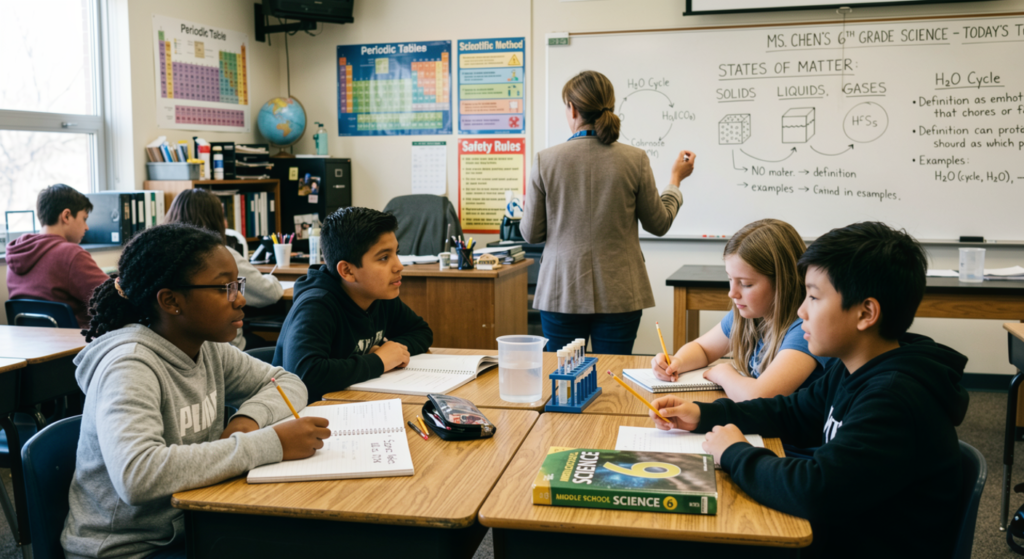

allredismyteacher refers to an Ohio educator who teaches 6th-grade science and STEAM. The teacher gained recognition after being named the 2023–2024 Learning Blade National Educator of the Year, highlighting their work in making science, technology, engineering, arts, and math more engaging for students.
For students, parents, and people interested in modern education, this story is especially relevant because STEAM teaching is about more than memorizing facts. It encourages students to ask questions, solve problems, experiment, create, and understand how different subjects connect. A middle-school science teacher working across these areas can have a meaningful influence on how young students approach learning.
What Does allredismyteacher Mean?
allredismyteacher appears to be an online identifier connected with a teaching-related subject. In the context provided, it refers to a 6th-grade science and STEAM teacher in Ohio who received the 2023–2024 Learning Blade National Educator of the Year recognition. The phrase itself can naturally be read as “Allred is my teacher,” although the exact origin or intended use of the username should not be assumed without a direct source from the account owner.
The important part of the topic is therefore the educator behind the reference. A teacher working with sixth-grade students occupies an interesting stage of education because students are moving from elementary learning into more specialized middle-school subjects. Science becomes more investigative, while STEAM activities can give students opportunities to apply what they learn.
Who Is the Teacher Behind allredismyteacher?
The educator associated with this topic is described as a 6th-grade science and STEAM teacher in Ohio. Their work centers on helping students engage with science while incorporating the broader STEAM approach, which brings together science, technology, engineering, arts, and mathematics.
Teaching these subjects at the sixth-grade level can involve much more than traditional classroom instruction. Students may investigate scientific questions, build models, work through engineering challenges, analyze information, or create projects that combine several areas of knowledge.
The teacher’s recognition as the 2023–2024 Learning Blade National Educator of the Year places their work within a broader conversation about innovative and effective educational practice. It also helps explain why an online identifier such as allredismyteacher may attract interest from people searching for information about this educator.
Why the Learning Blade Award Matters
Learning Blade is an educational program associated with career exploration and STEM learning. Being named National Educator of the Year for the 2023–2024 period indicates that the teacher’s educational work received recognition from the organization.
Awards can provide useful context, but they do not tell the entire story of a teacher’s classroom. The more interesting question is what makes this type of teaching valuable to students. In science and STEAM education, strong classroom experiences often give students opportunities to do something with information instead of simply receiving it.
A project, experiment, design challenge, or real-world problem can make an abstract lesson easier to understand. Students can see why a scientific concept matters and how it connects with technology, engineering, mathematics, or creative thinking.
Understanding the STEAM Approach
STEAM stands for Science, Technology, Engineering, Arts, and Mathematics. It expands on the more familiar STEM model by including the arts as another part of interdisciplinary learning.
The idea is not simply to place five subjects next to each other. Instead, STEAM activities can encourage students to use knowledge from different areas to work toward a common goal. A classroom project might involve understanding a scientific principle, designing a solution, calculating measurements, using technology, and presenting the final result creatively.
For sixth-grade students, this approach can make learning feel more active and connected to the world outside school. It also creates room for different kinds of strengths. One student might enjoy calculations, another might be good at designing, while someone else might be particularly comfortable explaining the group’s ideas.
What Makes Science Teaching Engaging for Sixth Graders?
Sixth graders are naturally at an age where curiosity can become a powerful learning tool. They are old enough to handle more complex scientific ideas, but they can still benefit enormously from hands-on experiences and questions that encourage exploration.
A science teacher can turn a lesson into an investigation by asking students to predict what will happen, test an idea, record observations, and explain their conclusions. That process helps students understand that science is not simply a collection of answers. It is also a method for finding and testing answers.
This style of learning can be particularly useful when combined with STEAM projects. Instead of stopping after understanding a scientific concept, students can be challenged to use that knowledge to create or improve something.
The Role of Technology in STEAM Classrooms
Technology has become an increasingly important part of education, but effective technology use is not simply about putting devices in students’ hands. The real value comes from using technology to support meaningful learning.
In a STEAM classroom, students might use digital tools to research a question, collect information, create a presentation, model an idea, or communicate the results of a project. These activities can help students develop skills that extend beyond a single science lesson.
For a teacher, this requires planning. Technology should serve the learning objective rather than become the objective itself. When used thoughtfully, it can give students additional ways to investigate and express what they understand.
How Engineering Fits Into Science Education
Engineering provides an especially useful connection between science and practical problem-solving. Scientists often work to understand how the world works, while engineers frequently apply knowledge to design solutions to problems.
That distinction can become meaningful for students when they are given a design challenge. They may need to identify a problem, develop possible solutions, build a model, test it, discover weaknesses, and make improvements.
Failure can actually be part of the lesson. If a design does not work the first time, students have an opportunity to examine what happened and try again. That experience teaches persistence in a way that a textbook explanation alone cannot easily reproduce.
The Importance of Arts in STEAM
The “A” in STEAM is sometimes misunderstood. Including arts does not mean that every science project needs to become an art assignment. Rather, creative thinking, communication, design, and visual expression can complement technical learning.
A student designing a model, explaining a scientific discovery, creating an educational presentation, or developing a visual representation may use artistic and creative skills alongside scientific reasoning.
This interdisciplinary approach can also make projects more accessible to students with different interests. Someone who does not immediately connect with a traditional science worksheet may become much more engaged when the same concept is presented through design or creative problem-solving.
Why a National Educator Recognition Draws Attention
When a teacher receives national recognition, people naturally want to know what happens inside that classroom. The award associated with the 2023–2024 Learning Blade National Educator of the Year title gives this topic a clear educational dimension.
It also highlights a broader point about teaching. Good education is not always about making lessons more complicated. Often, it is about finding ways to make difficult ideas understandable, relevant, and interesting to students.
For a sixth-grade science and STEAM teacher, that can mean creating classroom experiences where students are encouraged to question, test, build, revise, and explain. Those habits can remain useful long after a particular science unit is finished.
What Students Can Learn From STEAM Projects
One major benefit of STEAM learning is that students can develop several skills at the same time. A single project might involve research, communication, measurement, teamwork, creativity, and problem-solving.
Students can also learn that there may be more than one reasonable way to approach a problem. That is an important lesson because real-world problems rarely come with a worksheet showing exactly which formula or method to use.
Working collaboratively can add another layer. Students have to listen to other ideas, explain their own reasoning, divide responsibilities, and sometimes change their approach after receiving feedback.
A Teacher’s Influence Goes Beyond the Lesson
The significance of a teacher is not limited to the material covered during a school year. Teachers can influence how students think about themselves as learners.
A student who successfully completes a challenging experiment may become more comfortable with scientific subjects. Another student might discover an interest in engineering after building a successful prototype. Someone else may realize that creativity and science can work together.
That is one reason teacher recognition can be meaningful. Behind an award is usually a collection of ordinary classroom moments: questions from students, experiments that did not work, projects that needed revision, and those satisfying moments when a difficult idea finally makes sense.
What Parents Can Take From the allredismyteacher Topic
Parents searching for allredismyteacher may be interested not only in the educator but also in the teaching approach connected with the name. The STEAM model offers a useful way to think about modern science education.
Instead of asking only whether a child can remember scientific facts, parents can look at whether the child is learning to ask questions, explain ideas, solve problems, work with others, and apply information.
Those skills are useful across school subjects. They can also help children become more confident when faced with unfamiliar problems.
The Bigger Picture of Science and STEAM Education
The story connected with allredismyteacher reflects a larger shift toward interdisciplinary education. Science does not exist separately from technology, engineering, mathematics, communication, and creative thinking in the real world.
A student building a small structure, for example, may need scientific understanding, mathematical measurements, engineering decisions, digital research, and creative design. A classroom that brings these elements together can show students how knowledge works outside the boundaries of individual subjects.
That does not mean traditional teaching methods are unnecessary. Reading, writing, instruction, practice, and assessment remain important. STEAM can complement those foundations by giving students opportunities to apply what they have learned.
Conclusion
The keyword allredismyteacher becomes much easier to understand when viewed through its educational context. Rather than being treated simply as a random string of letters, it points toward a sixth-grade science and STEAM educator in Ohio and a notable recognition from Learning Blade.
What makes the subject interesting is the educational idea behind it. Science teaching can be about much more than remembering definitions. When students investigate questions, design solutions, use technology, work creatively, and learn from mistakes, they begin to see science as something they can actively do.
The 2023–2024 National Educator of the Year recognition provides an important part of the story, while the broader STEAM approach explains why this type of teaching can matter. For students, parents, and anyone interested in education, the topic offers a useful reminder: sometimes the most memorable lessons happen when students are given the chance to explore an idea rather than simply being told the answer.
Frequently Asked Questions
What is allredismyteacher?
allredismyteacher appears to be an online identifier associated with a teaching-related topic. In the context described here, it refers to a 6th-grade science and STEAM teacher in Ohio who was named the 2023–2024 Learning Blade National Educator of the Year.
Who is associated with allredismyteacher?
The keyword is associated with an educator identified as an Ohio 6th-grade science and STEAM teacher. The available description connects this teacher with the 2023–2024 Learning Blade National Educator of the Year recognition.
What does STEAM stand for?
STEAM stands for Science, Technology, Engineering, Arts, and Mathematics. It is an interdisciplinary approach that encourages students to connect knowledge and skills from these areas.
What grade does the teacher teach?
The educator associated with this topic is described as teaching 6th-grade science and STEAM in Ohio.
What award did the teacher receive?
The teacher was named the 2023–2024 Learning Blade National Educator of the Year, according to the description associated with this topic.
Why is STEAM useful for middle-school students?
STEAM can give students opportunities to apply classroom knowledge through investigation, design, creativity, technology, and problem-solving. It can also help students see connections between subjects that are often taught separately.
Is allredismyteacher the teacher’s official name?
Not necessarily. The term appears to function as an online identifier or phrase rather than the educator’s formal name. The exact origin and intended meaning of the username should be confirmed through a first-party profile or other reliable source.