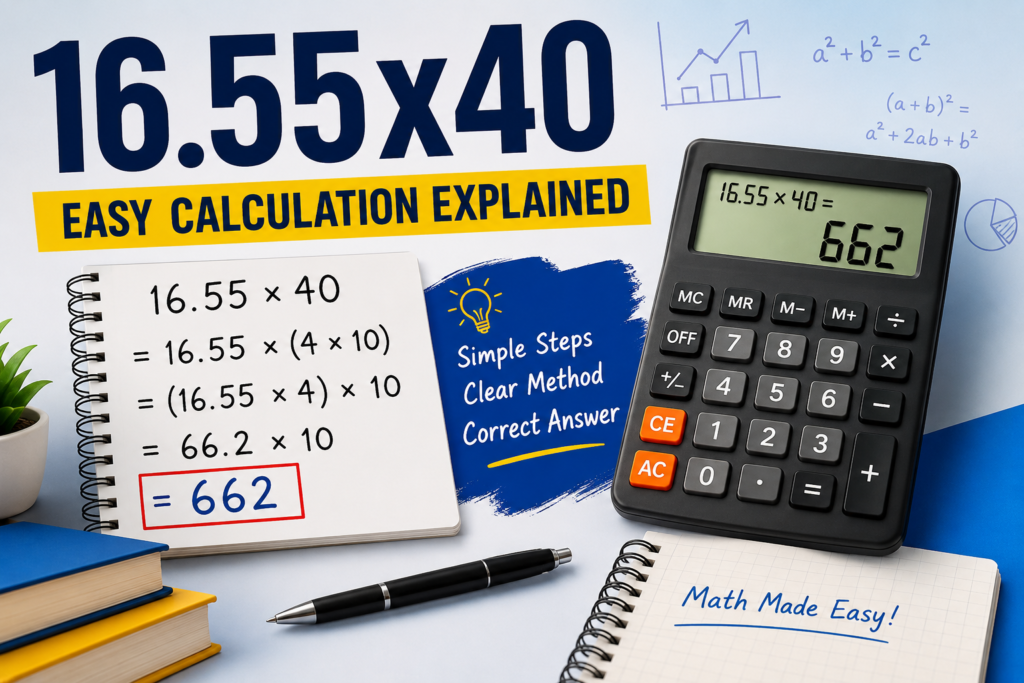

The answer to 16.55×40 is 662. This means that forty groups of 16.55 equal a total of 662. Many calculators provide this result instantly, but understanding how the calculation works helps you verify answers independently and strengthens your overall math skills. Since decimal multiplication appears frequently in finance, education, retail, and engineering, knowing how to confirm results is always beneficial.
What Is 16.55×40
The expression 16.55×40 represents a multiplication problem where the decimal number 16.55 is multiplied by the whole number 40. In mathematics, the letter “x” commonly means multiplication. When we multiply these two numbers together, we are essentially adding 16.55 forty times, although multiplication provides a much faster and more efficient way to reach the answer. The final result is 662, making this a straightforward yet valuable example of decimal multiplication.
How to Calculate 16.55×40 Manually
You can calculate 16.55×40 by first multiplying 16.55 by 4, which equals 66.2, and then multiplying that result by 10 because 40 equals 4 × 10. Multiplying 66.2 by 10 simply moves the decimal one place to the right, producing 662. This method avoids complicated calculations while making it easier to understand how multiplying by multiples of ten affects decimal numbers.
Why Decimal Multiplication Matters
Decimal multiplication is used every day, even if many people do not realize it. Prices, measurements, taxes, fuel consumption, salaries, and discounts often involve decimal numbers. Calculations like 16.55×40 help people determine total costs, estimate material requirements, or calculate wages. Once you understand the basic principles, similar calculations become much easier to solve mentally or with minimal effort.
Understanding the Mathematical Formula
The formula for 16.55×40 follows the standard multiplication rule. A decimal number can be multiplied by a whole number exactly as an integer would be, while keeping track of decimal placement. In this example, multiplying by 40 is equivalent to multiplying by 4 and then by 10, simplifying the calculation without changing the result. This mathematical property makes many decimal problems easier to solve.
Breaking Down the Numbers
The number 16.55 consists of sixteen whole units and fifty-five hundredths. When multiplied by forty, both the whole number portion and the decimal portion increase proportionally. The whole number component contributes most of the final value, while the decimal component adds the remaining amount. Together they combine perfectly to produce the final answer of 662.
Real-Life Shopping Example
Imagine a store sells an item for $16.55, and you need to purchase forty identical items. Instead of adding the price repeatedly, you simply calculate 16.55×40. The result shows that the total cost before taxes or discounts would be $662. Businesses perform similar calculations every day for invoices, inventory management, and customer purchases.
Business and Accounting Applications
Businesses rely heavily on multiplication involving decimals. If an employee earns $16.55 per hour and works forty hours during the week, the gross weekly earnings equal $662 before deductions. This example demonstrates how 16.55×40 directly applies to payroll, budgeting, and financial planning in many industries.
Construction and Material Estimation
Construction professionals often multiply decimal measurements by quantities to estimate material costs or dimensions. If a building material costs $16.55 per unit and forty units are required, calculating 16.55×40 immediately provides the estimated material expense. Quick calculations like this improve planning accuracy and help reduce costly mistakes.
Educational Importance of 16.55×40
Teachers frequently use decimal multiplication examples because they reinforce several important mathematical concepts at once. Problems such as 16.55×40 teach place value, multiplication strategies, estimation, and decimal accuracy. Students who understand these principles usually perform better when solving more advanced mathematical problems later.
Common Mistakes to Avoid
One of the most common mistakes in decimal multiplication is placing the decimal point incorrectly. Another error occurs when someone multiplies by 4 instead of 40, forgetting the additional factor of ten. Checking your work by estimating the answer first can help identify these mistakes. Since 16.55 is close to 17, multiplying 17 by 40 gives approximately 680, making the exact answer of 662 seem perfectly reasonable.
Using Estimation for Verification
Estimation is an excellent way to verify multiplication results. Rounding 16.55 to 16.5 gives an estimated answer of 660, while rounding it to 17 gives approximately 680. Since the actual answer, 662, falls comfortably within this expected range, estimation confirms that the calculation is accurate without requiring another complete solution.
Calculator Versus Mental Math
Modern calculators provide instant answers, but mental math remains valuable. By recognizing that forty equals four multiplied by ten, many people can quickly solve 16.55×40 without technology. Developing this skill improves confidence and speeds up everyday calculations involving prices, wages, distances, and measurements.
Decimal Multiplication in Daily Life
Everyday life presents countless situations requiring decimal multiplication. Grocery shopping, travel expenses, restaurant bills, fuel purchases, hourly wages, and home improvement projects all involve calculations similar to 16.55×40. Understanding these basic operations allows people to make faster financial decisions and better manage their budgets.
Why Learning the Process Is Better Than Memorizing
Simply memorizing that 16.55×40 equals 662 may help temporarily, but understanding the calculation process provides long-term value. Once you learn how decimal multiplication works, you can solve thousands of similar problems with confidence instead of depending entirely on calculators or memorized answers.
Conclusion
The calculation 16.55×40 may seem simple at first glance, but it demonstrates several useful mathematical concepts that apply to everyday life. The exact answer is 662, and reaching that result becomes much easier once you understand decimal multiplication and the relationship between multiples of ten. Whether you are calculating payroll, estimating shopping expenses, solving homework problems, or managing a business budget, the same principles apply. Rather than memorizing isolated answers, learning the reasoning behind the calculation equips you with skills that can be used in countless situations, making even a basic multiplication problem both practical and valuable.
Frequently Asked Questions About 16.55×40
Many people search for multiplication problems because they want quick answers while also understanding the reasoning behind them. Below are answers to some of the most common questions related to 16.55×40.
Is 16.55×40 equal to 662?
Yes. Multiplying 16.55 by 40 gives the exact result of 662.
How can I calculate 16.55×40 without a calculator?
Multiply 16.55 by 4 to get 66.2, then multiply by 10 because 40 equals 4 × 10. The final answer is 662.
Why is decimal multiplication important?
Decimal multiplication is widely used in finance, education, engineering, shopping, construction, and everyday budgeting because many real-world values include decimal numbers.
Can I estimate the answer before calculating?
Yes. Rounding 16.55 to approximately 16.5 gives an estimated result of around 660, which is very close to the exact answer of 662.
Where is 16.55×40 commonly used?
This calculation may appear when determining weekly wages, calculating the cost of multiple products, estimating project expenses, or solving educational math problems.
Does multiplying by 40 always mean multiplying by 4 and then by 10?
Yes. Since 40 equals 4 × 10, breaking the multiplication into two simpler steps is often an easy and accurate method.
Read also: What Is Ashggruel? A Complete Guide to the Online Username