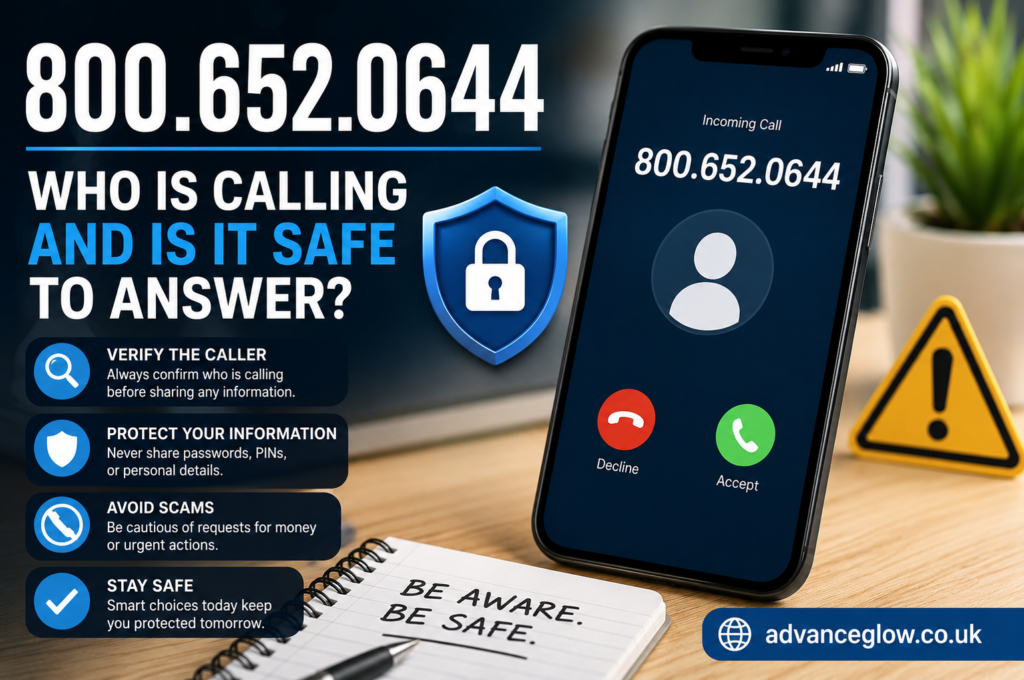

800.652.0644 is formatted as a toll-free telephone number in North America. Toll-free numbers allow callers to contact businesses or organizations without paying long-distance charges.
A toll-free number itself doesn’t automatically identify the caller. Many different organizations use 800 numbers for:
- Customer support
- Billing departments
- Appointment reminders
- Government services
- Healthcare providers
- Financial institutions
- Shipping companies
- Technical support
Because caller ID information can sometimes be spoofed, it’s important to verify who is actually calling rather than assuming the displayed number is genuine.
Quick Answer
If you’re searching for 800.652.0644, here’s the short answer:
- It is an 800 toll-free number.
- The number alone does not confirm who is calling.
- Never provide passwords, banking details, Social Security numbers, or verification codes unless you’ve independently verified the caller.
- If you’re unsure, contact the organization directly using its official website or customer service number.
Why Would You Receive a Call From 800.652.0644?
There are several legitimate reasons someone might call from this number.
Customer Service Follow-Up
Many companies contact customers regarding:
- Recent purchases
- Warranty information
- Support tickets
- Service requests
- Product deliveries
If you’ve recently contacted a company’s support department, a callback from a toll-free number is common.
Billing Questions
Businesses often use centralized toll-free numbers for:
- Payment reminders
- Invoice questions
- Account verification
- Subscription renewals
Always verify that the caller represents the company they claim to work for before discussing your account.
Appointment Confirmation
Healthcare providers, clinics, and service businesses frequently call customers to:
- Confirm appointments
- Reschedule visits
- Send reminders
- Share preparation instructions
These calls are usually brief and informational.
Security Verification
Banks and online services sometimes call customers about unusual account activity.
However, legitimate organizations generally will not ask for:
- Full passwords
- PIN numbers
- One-time security codes
- Complete debit card numbers
If they do, end the call immediately.
Could 800.652.0644 Be a Scam?
Unfortunately, any phone number—including toll-free numbers—can appear on your caller ID through caller ID spoofing.
Scammers often imitate trusted organizations to convince people to reveal sensitive information.
This means even if 800.652.0644 appears legitimate, you should still verify the caller independently.
Common Phone Scam Techniques
Understanding common scam tactics can help you stay protected.
Urgency
Scammers often create panic by saying:
- Your account has been suspended.
- Your payment failed.
- Legal action is pending.
- Your identity has been stolen.
Pressure is a major warning sign.
Requests for Personal Information
Legitimate businesses rarely ask for:
- Full Social Security numbers
- Complete credit card numbers
- Online banking passwords
- Email passwords
- Authentication codes
Never share this information during an unsolicited call.
Gift Card Payments
If someone asks you to pay using:
- Apple Gift Cards
- Google Play cards
- Steam cards
- Cryptocurrency
- Wire transfers
it’s almost certainly a scam.
Threats
Some callers threaten:
- Arrest
- Tax penalties
- Utility disconnection
- Immigration consequences
Government agencies generally do not make these types of threats over unexpected phone calls.
How to Verify 800.652.0644
If you’re unsure who called, use these verification steps.
Check Recent Activity
Ask yourself:
- Did I recently contact customer support?
- Am I expecting a package?
- Do I have an upcoming appointment?
- Did I submit an online application?
The call may be related.
Search the Number
Many people search unknown numbers online to see whether others have reported:
- Scam activity
- Telemarketing
- Customer service experiences
- Legitimate business use
Reading multiple reports can provide useful context, though individual experiences may vary.
Contact the Company Directly
If the caller claimed to represent a specific organization:
- Hang up.
- Visit the organization’s official website.
- Call the published customer service number.
- Ask whether someone attempted to contact you.
This is one of the safest ways to verify a call.
What If They Leave a Voicemail?
Voicemail messages often reveal useful clues.
Listen for:
- Company name
- Employee name
- Reference number
- Department
- Callback reason
Be cautious if the message includes threats, demands immediate payment, or requests confidential information.
Should You Call Back?
It depends.
Calling back may be reasonable if:
- You’re expecting a callback.
- The voicemail sounds legitimate.
- You can confirm the organization independently.
Avoid returning the call if:
- The caller demanded immediate payment.
- They threatened legal action.
- The voicemail sounded suspicious.
- They requested sensitive information.
Signs the Call Is Legitimate
A legitimate caller usually:
- Clearly identifies the organization.
- Explains the reason for calling.
- Allows you time to verify.
- Doesn’t pressure you.
- Doesn’t request passwords.
- Encourages you to call official customer support if you have concerns.
Signs the Call May Be Fraudulent
Be cautious if the caller:
- Demands immediate payment.
- Creates unnecessary panic.
- Refuses verification.
- Asks for banking credentials.
- Requests one-time verification codes.
- Wants remote access to your computer.
- Becomes aggressive when questioned.
These are common scam indicators.
Caller ID Spoofing Explained
Caller ID spoofing allows scammers to display almost any phone number they choose.
Because of this:
- The displayed number may not belong to the actual caller.
- Even trusted company numbers can be spoofed.
- Verifying the caller is more important than trusting caller ID.
What to Do If You Answered the Call
Don’t panic.
If you answered but didn’t share personal information, there’s usually nothing else you need to do.
If you did provide sensitive information:
- Change passwords immediately.
- Contact your bank.
- Monitor financial accounts.
- Enable two-factor authentication.
- Watch for suspicious transactions.
- Consider placing a fraud alert if appropriate.
Acting quickly can reduce potential risks.
How to Block Unwanted Calls
Most smartphones allow you to block individual numbers.
You can also:
- Enable spam call filtering.
- Use your carrier’s spam protection service.
- Install trusted call-screening apps.
- Report scam calls to relevant consumer protection agencies.
Blocking won’t stop every unwanted call, but it can reduce repeat attempts.
Tips to Stay Safe From Phone Scams
Good phone security habits go a long way.
Remember these best practices:
- Never rush into making payments.
- Verify every unexpected caller.
- Don’t share verification codes.
- Ignore pressure tactics.
- Use official contact information.
- Keep your devices updated.
- Educate family members about common scams.
These habits can help protect both your personal information and your finances.
Why People Search Numbers Like 800.652.0644
Online searches for unknown phone numbers have become increasingly common because people want reassurance before returning a call.
Common reasons include:
- Missed calls
- Suspicious voicemail
- Debt collection concerns
- Banking notifications
- Customer service callbacks
- Fraud prevention alerts
Searching first helps people make informed decisions instead of reacting emotionally.
Best Practices Before Returning Any Unknown Call
Before calling back:
- Listen to the voicemail.
- Search the number.
- Verify the organization.
- Use official contact information.
- Avoid sharing personal details.
- Stay calm if the caller claims there’s an emergency.
These simple steps significantly reduce the risk of becoming a victim of fraud.
Conclusion
Receiving a call from 800.652.0644 doesn’t automatically mean something is wrong. It could be a legitimate customer service call, an appointment reminder, or another routine communication. However, because caller ID spoofing is common, it’s always wise to verify who is contacting you before sharing any personal information.
The safest approach is simple: if you’re uncertain, end the call and reach out to the organization using the official contact information found on its website or official documents. A few extra minutes of verification can protect you from costly scams and identity theft.
Frequently Asked Questions
1. Is 800.652.0644 a scam number?
Not necessarily. The number is a toll-free number, but the displayed caller ID alone doesn’t confirm whether the caller is legitimate. Always verify the caller independently.
2. Should I answer calls from 800.652.0644?
If you’re expecting a call from a business or organization, you may answer. If you’re unsure, let the call go to voicemail and review the message first.
3. Can scammers use legitimate-looking 800 numbers?
Yes. Caller ID spoofing allows scammers to make calls appear as though they come from trusted toll-free numbers.
4. What information should I never give over the phone?
Never share passwords, PINs, one-time verification codes, full banking credentials, or other sensitive personal information during an unsolicited call.
5. How do I verify who called me?
Contact the organization directly using the phone number listed on its official website rather than relying on the number shown in your caller ID.
Read also: Floutss The Traditional Crispy Rolled Tortilla Dish Everyone Loves